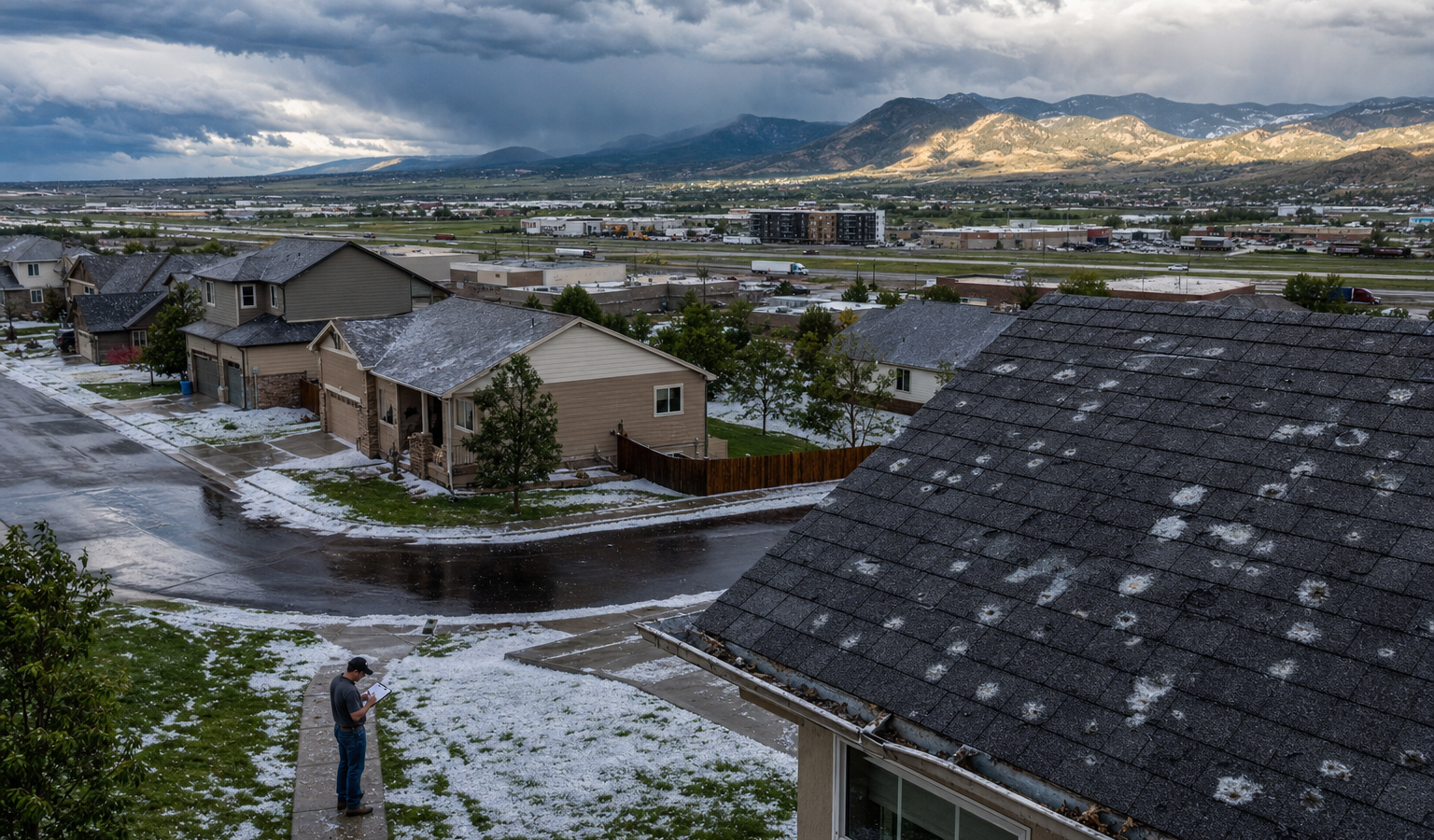
Colorado’s June 2026 hail storms brought another round of severe weather to the Front Range, with some communities seeing heavier impacts than others. For homeowners and property managers, the key question is not just where hail fell, but where roof damage, siding hits, gutter dents, and insurance claim issues are most likely. In Colorado’s Hail Alley, even a short storm can create costly damage that is easy to miss from the ground, which is why post-storm inspection matters in the hardest-hit areas.
Why June hail causes so many roofing problems
June is one of the most active hail months along the Front Range. Warm, unstable air, frequent afternoon thunderstorms, and strong wind shifts can produce hail that varies a lot from one neighborhood to the next. That matters because two homes in the same city can have very different damage depending on storm track, hail size, wind direction, roof slope, and the age of the roofing system.
The biggest problem after a June storm is that visible signs often lag behind the event itself. A roof may not leak right away, but asphalt shingles can lose granules, matting can bruise, seal strips can weaken, and flashing can take hits that shorten the life of the system.
Common storm-related issues include:
- Granule loss on asphalt shingles
- Bruising or fracturing in shingle mats
- Dents on metal vents, flashing, gutters, and downspouts
- Cracked or displaced ridge caps
- Damage to siding, window screens, and soft metals
- Water entry around penetrations after wind-driven rain
If your property was in or near a heavier storm corridor, a prompt hail damage inspection is usually the smartest next move.
Which Front Range communities were hit the hardest?
The Front Range rarely gets hit evenly. In most June storm cycles, the hardest-hit communities are the ones under the strongest cells, the longest hail duration, or repeated storm paths over a few days. Based on how these events typically affect the region, the communities most likely to see heavier June 2026 hail impacts are the usual high-exposure corridor from the northern metro area through the I-25 belt and eastward plains-facing suburbs.
High-risk metro and suburban zones
Communities along and just east of I-25 often take the brunt of organized hail events. In a June pattern, the harder-hit areas commonly include:
- Fort Collins
- Windsor
- Loveland
- Greeley
- Longmont
- Broomfield
- Westminster
- Thornton
- Northglenn
- Commerce City
- Brighton
- Aurora
- Parker
- Castle Rock
These areas are frequently exposed to storms that intensify as they move off the foothills and organize over the plains. Neighborhoods on the east and southeast sides of these communities often see stronger hail and wind-driven damage, especially where storms maintain intensity for several miles.
Denver-area neighborhoods with patchy but significant damage
In the Denver metro, hail damage is often extremely localized. One subdivision may have obvious dents on gutters and torn screens, while a neighborhood a few miles away may only see rain. That makes city-wide assumptions risky.
In the June 2026 storm pattern, properties in these types of locations should be especially cautious:
- Open, newer subdivisions with broad wind exposure
- Areas east of major freeway corridors
- Neighborhoods that experienced repeated cells within a short period
- Commercial properties with large, low-slope roof surfaces
For commercial owners and managers, even moderate hail can matter if the roof membrane, metal edge details, or rooftop units took repeated hits. Our commercial roofing services are often called after storms where damage is subtle but widespread.
Eastern Front Range communities often see stronger hail cores
Once storms strengthen east of the foothills, communities closer to the plains can take larger hail or longer-duration impacts. That includes places such as:
- Brighton and the surrounding Adams County area
- Eastern Aurora
- Bennett and Strasburg corridors
- Parts of Weld County
- Communities along open east-west wind paths
These areas are worth watching because hailstones can stay intact longer over the plains, and wind can increase the force of impact on roofing, siding, and windows.
What “hardest hit” really means for your roof
A community can be labeled hard hit for several different reasons, and not all of them mean the same repair scope.
Hail size is only part of the story
Larger hail gets attention, but smaller hail can still create real damage when:
- Wind increases impact speed
- A storm stalls over one area
- The roof is older or already weathered
- Shingles are warm and more vulnerable to bruising
- The property takes multiple storms in the same month
That is why a roof with no obvious leaks can still qualify for repair or replacement after a severe storm.
Exposure and roof type matter
The same storm affects materials differently. For example:
- Asphalt shingles may show granule loss or bruising
- Metal roofing may show cosmetic or functional denting depending on system type
- Tile and synthetic products can crack, chip, or fracture
- Low-slope commercial systems may show membrane stress, punctures, or damage at accessories
A proper inspection looks at the full roofing system, not just the field shingles.
Signs your property may have storm damage
If your community was under a stronger June 2026 hail cell, look for signs on the ground and around the exterior before assuming the roof is fine.
Exterior clues homeowners notice first
- Fresh dents on gutters, downspouts, garage doors, or metal window wraps
- Torn or punctured window screens
- Granules collecting at downspout outlets
- Chipped paint or marks on decks, fences, and exterior fixtures
- Pieces of shingle or ridge cap on the ground
- Water staining that appears after the storm
Less obvious signs that need a roof inspection
Some of the most important issues are the least visible from the yard:
- Bruised shingles that feel soft under light test pressure
- Circular impact marks with displaced granules
- Damaged flashing around vents, skylights, and chimneys
- Lifted or weakened tabs after hail and wind together
- Membrane or coating damage on low-slope commercial roofs
This is where a documented inspection helps. At AC INC. Roofing, our team includes HAAG Certified Master Inspectors, which matters because storm documentation needs to be clear, systematic, and usable during an insurance claim.
What to do if your area was in a June 2026 hail path
If you think your neighborhood was one of the harder-hit Front Range communities, take these steps in order.
- Document the date of the storm. Save weather alerts, photos, and any neighborhood reports.
- Walk the property safely from the ground. Look for dents, displaced materials, and screen damage.
- Do not climb the roof yourself. Hail-damaged roofs can be slick, and subtle damage is easy to misread.
- Schedule a professional inspection. A trained inspector can separate cosmetic marks from functional roof damage.
- Review repair versus replacement options. Some roofs need targeted repairs; others may justify a full roof replacement estimate.
- If needed, start the insurance claim process. Good photo documentation and test-area notes can make a major difference.
If the damage is limited, smaller fixes may be appropriate. You can also learn more about roof repair pricing before deciding on next steps.
Why inspection quality matters after Front Range hail
After a major storm, many property owners get conflicting opinions. One contractor says the roof is totaled. Another says it is only cosmetic. The difference is often inspection quality.
A reliable hail inspection should include:
- Review of all roof slopes, not just the easiest one to access
- Examination of soft metals and collateral indicators
- Photo documentation of damage and non-damage areas
- Assessment of flashing, penetrations, ridge, valleys, and accessories
- Clear explanation of whether the issue appears repairable or replacement-level
- Documentation that supports an insurance adjuster review when applicable
For homeowners, this avoids guesswork. For commercial managers, it helps with maintenance records, budgeting, and tenant protection.
If your property is in the Front Range or nearby Wyoming markets, our residential roofing team and commercial crews can help determine what the storm actually did to your system.
Don’t assume “no leaks” means “no damage”
One of the most common post-storm mistakes is waiting for interior water stains before acting. Hail damage often starts by shortening roof life, loosening protective surfaces, or creating weak points around penetrations. By the time a leak shows up, the repair may be more invasive than it would have been right after the storm.
That is especially true in the Front Range, where a hail event in June is often followed by more heat, UV exposure, and additional summer storms. A roof that was only marginally damaged can deteriorate faster over the rest of the season.
Next step
If your neighborhood may have been in one of the hardest-hit areas from Colorado’s June 2026 hail storms, schedule a free inspection before minor damage turns into a bigger repair or insurance issue. Contact AC INC. Roofing through our contact page to set up a residential or commercial roof evaluation.