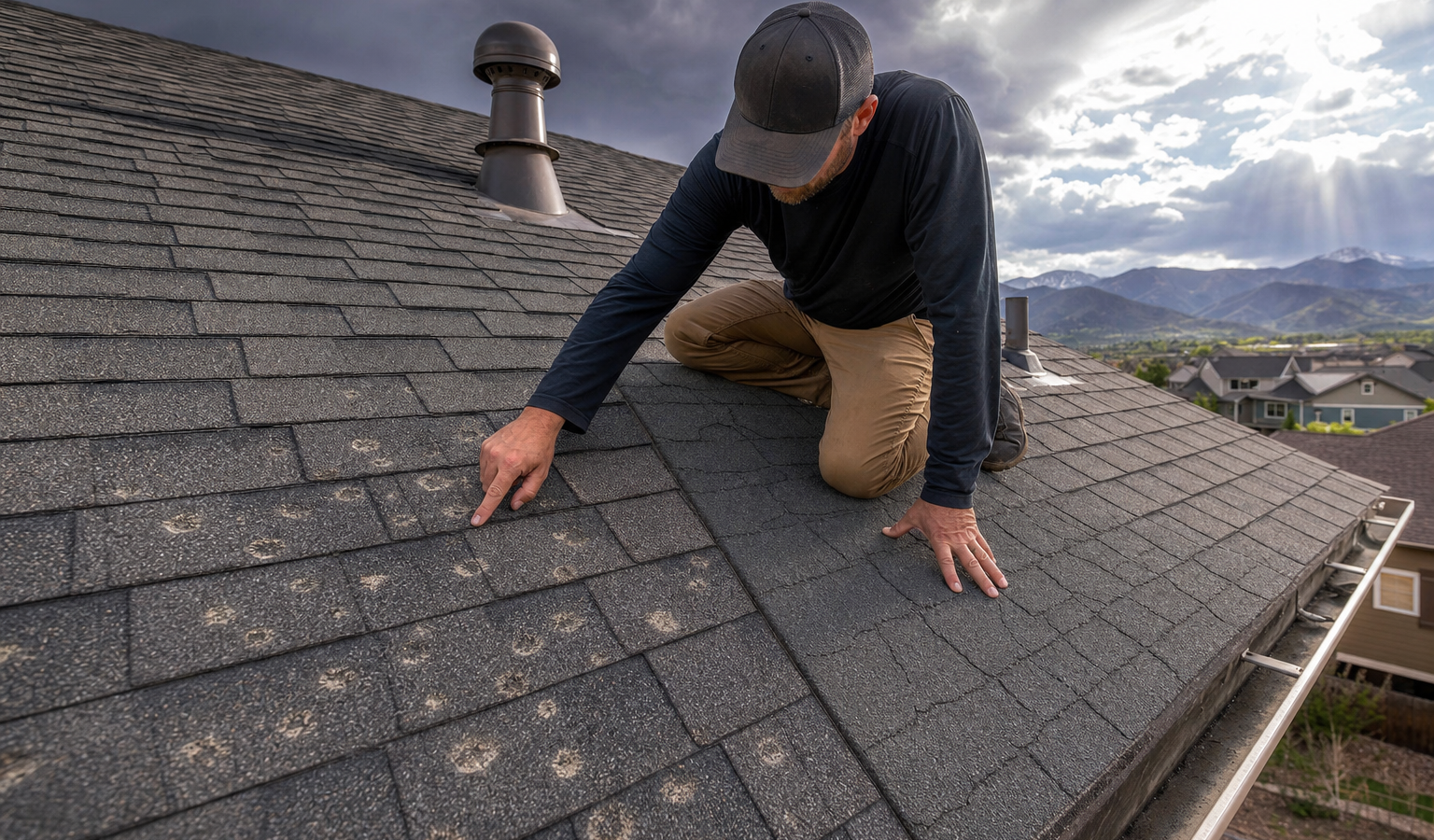
If you are looking at cracked, split, or missing shingles after a storm, it is reasonable to ask whether you have hail damage or a manufacturing defect. In Colorado, that distinction matters because it affects whether your roof needs a repair or full roof replacement, whether an insurance claim is appropriate, and how quickly the problem can spread. A qualified roofer should inspect the pattern, location, and type of shingle damage before giving you an answer.
Why the difference matters
Hail damage and manufacturing defects can look similar from the ground, especially on older asphalt shingles. Both can lead to granule loss, fractures, leaks, and premature aging. But the cause is not the same, and that changes the next step.
Here is why the distinction is important:
- Insurance claims are based on accidental direct physical loss, such as storm impact, not normal wear or a product defect.
- Repairs may fail if the root cause is missed. Replacing a few shingles on a defective roof does not solve a system-wide problem.
- Defects often show broader, repeating patterns, while hail damage is more random and tied to storm direction and roof exposure.
- A roof replacement decision should be based on evidence, not just on age or one photo.
For Colorado homeowners, this comes up often because the Front Range sits in Hail Alley, where roofs can have real storm impacts layered on top of age-related wear.
What hail damage usually looks like
Hail damage on asphalt shingles tends to leave evidence of impact. A trained inspector is not just looking for dents or rough spots. They are looking for a pattern that makes sense for the storm.
Common signs of hail damage
- Random impact marks across the slope, not evenly repeated in the same place on every shingle
- Granule loss with fresh asphalt exposed in localized spots
- Bruising that feels soft when gently tested by hand
- Circular or slightly irregular hits where hail struck the mat
- Damage to soft metals, such as vents, flashing, gutters, downspouts, or window screens nearby
- Heavier damage on the slopes that faced the storm
On laminate or architectural shingles, hail damage can be harder to read than on older three-tab shingles. The shingle design, color blend, age, and heat exposure can all affect how obvious the impact marks appear.
What roofers check beyond the shingles
A credible hail inspection should include collateral evidence. That means looking at components around the roof to see whether the storm story is consistent.
Inspectors often check:
- Metal roof vents and flashings
- Gutters and downspouts
- AC fins or condenser covers
- Siding and painted surfaces
- Skylight frames and screens
- Fences, decks, or exterior furniture where visible
If there is no supporting evidence anywhere on the property, that does not automatically rule out hail damage. But it does make the inspection more dependent on close shingle analysis.
If you suspect storm impacts, our hail damage inspection services focus on documenting exactly what is present and what is not.
What a manufacturing defect usually looks like
A manufacturing defect tends to show a different pattern. Instead of isolated, storm-related impact marks, the damage may appear as widespread cracking, splitting, blistering, curling, or early granule loss that does not line up with a specific weather event.
Common signs of shingle defects
- Repeating cracks in similar areas across many shingles
- Premature granule loss without clear impact points
- Blistering or surface flaws that formed during production or early aging
- Thermal splitting that follows stress lines rather than hail strike locations
- Uniform failure across multiple slopes, including protected areas
- A brittle or inconsistent shingle mat that breaks more from age or composition problems than impact
Some defects become visible only after the roof has been through heat, cold, UV exposure, and freeze-thaw cycles. Colorado roofs deal with all of that, so weak shingles often reveal themselves faster here than in milder climates.
Defect-related issues can be mistaken for storm damage
This is where many property owners get mixed answers. A brittle shingle can crack during handling, wind movement, foot traffic, or thermal expansion. From a quick glance, that crack may be blamed on hail. But if the mark lacks impact characteristics and appears in a repeated pattern, it may point to a product or aging issue instead.
That does not mean the roof is fine. It means the cause may not support an insurance claim the same way documented hail damage would.
How Colorado roofers tell the difference
An experienced roofer should use more than one clue. The answer usually comes from combining roof evidence, weather context, and test areas rather than relying on a single shingle photo.
1. Pattern analysis
Hail damage is usually random. Defects are often repetitive.
Roofers ask:
- Are the marks scattered or uniform?
- Do they line up across many shingles in similar locations?
- Is one slope worse because it faced the storm?
- Are protected or shaded areas failing in the same way as exposed areas?
2. Damage characteristics
The actual shape and feel of the damaged area matters.
Roofers look for:
- Soft bruising under the surface
- Fresh granule displacement
- Fractures with an impact center
- Splits that follow the shingle structure instead of a strike point
- Surface wear that looks aged rather than sudden
3. Collateral evidence
Storm damage usually leaves clues on more than one component.
If shingles show alleged hail damage, inspectors also want to see whether nearby metal and soft surfaces show corresponding hits. Consistency strengthens the conclusion.
4. Roof age and condition
Older roofs can have both problems at once: genuine hail damage plus deterioration from age, installation problems, or manufacturing issues. A good inspection should say that clearly rather than forcing everything into one category.
5. Weather history
Roofers may compare the observed damage to recent storm dates, hail size reports, and wind direction. Weather history does not replace physical inspection, but it can support or challenge what the roof is showing.
Why this matters for your insurance claim
If you file an insurance claim for hail damage, the adjuster will want to see evidence of storm-related impacts, not just roof wear. This is why documentation matters.
A solid inspection report should help answer:
- Is there functional or cosmetic hail damage?
- How many slopes are affected?
- Is there supporting damage to metals or other exterior components?
- Are there signs of wear, defect, or mechanical damage that should be separated from storm damage?
- Is repair reasonable, or is roof replacement more appropriate?
At AC INC. Roofing, we approach this the way carriers expect: identify the cause, document the condition, and avoid overstating what the roof shows. That is especially important for homeowners navigating a claim for the first time.
If the inspection confirms storm damage, we can help you understand the repair scope or whether a full roof replacement for your home or commercial property makes more sense.
Common misdiagnoses homeowners should avoid
A few mistakes come up again and again after Colorado storms.
“Every granule loss spot is hail”
Not necessarily. Granule loss can happen from weathering, foot traffic, mechanical damage, or shingle defects. Hail usually has a clearer impact signature.
“If the roof leaks after a storm, it must be hail”
Leaks often show up after storms because heavy rain exposes existing weak spots. The timing alone does not prove hail damage.
“A denied claim means there is no roof problem”
Also not true. A roof may still need repair or replacement because of age, installation issues, or a manufacturing defect even if insurance does not cover the cause.
“One damaged slope means the whole roof is defective”
Sometimes one slope takes the brunt of sun, wind, or storm exposure. The full roof should be inspected before drawing conclusions.
What to do if you are not sure which one you have
If you suspect either hail damage or a manufacturing defect, the safest move is to get a detailed inspection before filing paperwork or approving repairs.
Use this checklist:
- Take photos from the ground of visible issues and any fallen shingle pieces
- Note the date of the most recent storm you suspect
- Look for dents on gutters, vents, downspouts, or other metal surfaces
- Check ceilings and attic areas for fresh water staining
- Avoid climbing the roof yourself if conditions are unsafe
- Schedule a professional inspection with documented findings
If your roof only needs limited work, you can review general repair information here. If the damage is broader, it may be time to discuss full-scope options and roofing pricing considerations.
The value of a trained inspection
The biggest difference between a quick opinion and a useful inspection is documentation. Anyone can say a roof looks bad. A qualified inspector should be able to explain why the damage points to hail, defect, wear, or a combination.
That means:
- Close-up photos of representative areas
- Notes on slope orientation and severity
- Comparison of shingle damage to nearby collateral indicators
- Clear separation of storm damage from non-storm conditions
- Recommendations for repair versus replacement
This is especially helpful in Colorado and Wyoming markets like Cheyenne, where storm activity and temperature swings can make roof conditions more complex than they first appear.
Next step
If you are trying to sort out hail damage versus a manufacturing defect, get an inspection before making assumptions or starting an insurance claim. AC INC. Roofing provides free roof inspections and estimates for homeowners and commercial properties across Colorado and Wyoming. Contact us through our contact page to schedule a no-pressure evaluation.