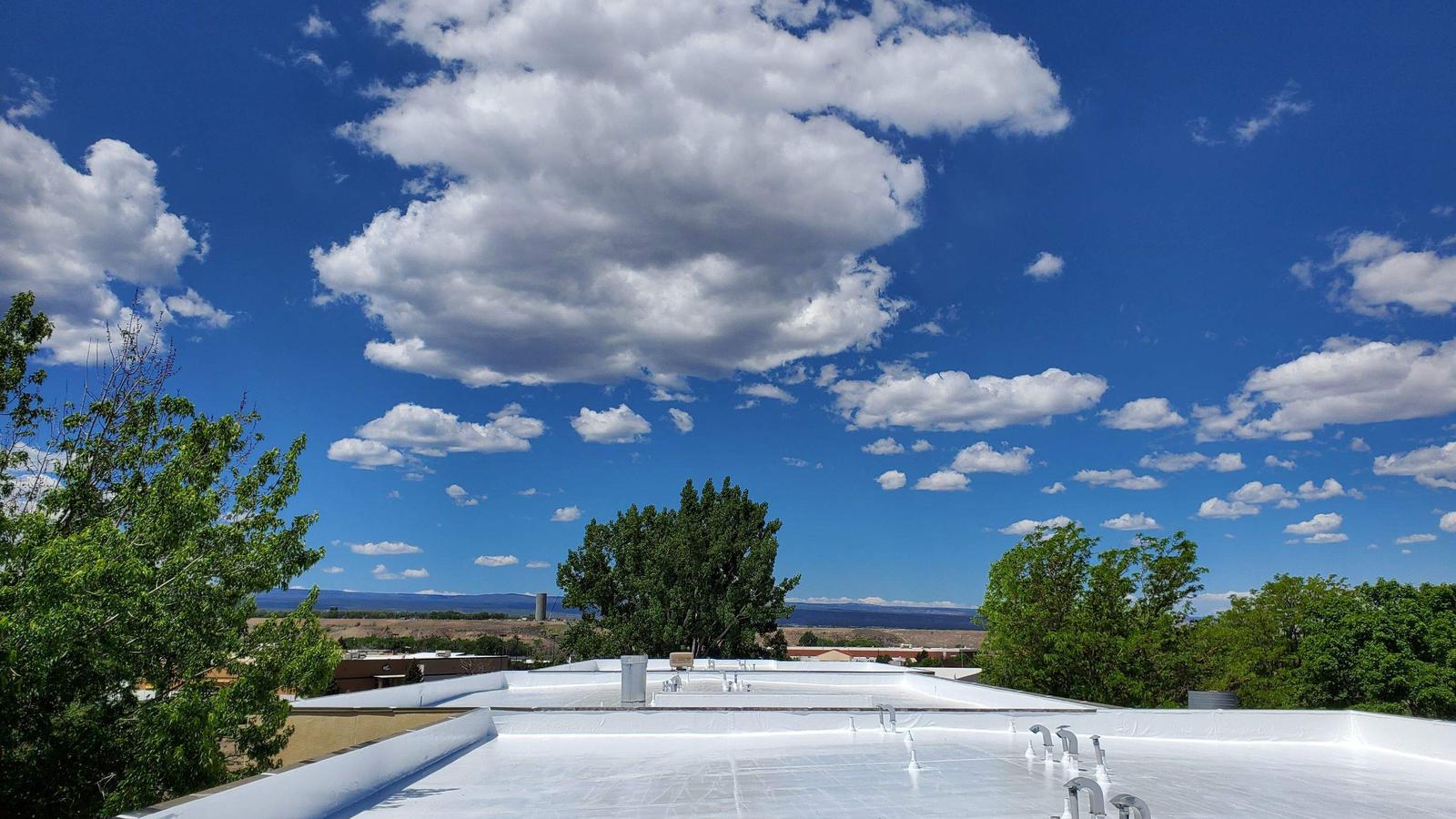
If you are comparing the best commercial roofing for flat roofs in Colorado, the right answer depends on your building’s exposure, budget, drainage, and long-term maintenance plan. Along the Front Range and in Wyoming, commercial roofs have to handle hail, high winds, strong UV, snow load, and large temperature swings, so the “best” system is usually the one that balances durability, energy efficiency, repairability, and life-cycle value rather than just the lowest upfront cost.
What Colorado weather demands from a flat roof
Commercial flat and low-slope roofs in Colorado and southeast Wyoming take a beating. A roof that performs well in a mild climate may not hold up the same way in Hail Alley.
Key stressors include:
- Hail impact that can bruise membranes, fracture surfacing, and damage seams or flashing
- Rapid freeze-thaw cycles that exploit weak details around drains, parapet walls, and penetrations
- Intense UV exposure at elevation, which accelerates aging in lower-grade materials
- High winds that test edge securement and attachment methods
- Snow and ponding concerns on buildings with poor drainage or aging insulation layouts
That is why commercial property owners should evaluate more than product brochures. The best system for your building should match:
- The roof’s slope and drainage pattern
- Existing roof condition and whether a tear-off is needed
- Foot traffic from HVAC or maintenance crews
- Expected ownership horizon
- Insurance and hail-damage risk
- Whether future repairs can be made easily and reliably
For many properties, a professional inspection is the first step before choosing between commercial roofing options.
TPO roofing: a common choice for energy efficiency
TPO, or thermoplastic polyolefin, is one of the most common commercial flat-roof systems used on offices, retail buildings, multifamily properties, and light industrial facilities.
Why owners choose TPO
TPO is popular because it offers a strong mix of performance and value:
- Reflective surface helps reduce heat gain in warmer months
- Heat-welded seams can provide a strong, watertight connection when installed correctly
- Lightweight system compared to some built-up options
- Widely used across many commercial building types
In Colorado weather, TPO can be a good fit for buildings where energy efficiency and clean drainage design matter. White and light-colored membranes are especially attractive for owners looking to reduce rooftop heat absorption.
Where TPO performs well
TPO is often a strong option when:
- The building has a relatively clean, open roof layout
- Good drainage already exists or will be improved during replacement
- The owner wants a balance of upfront cost and modern performance
- Energy efficiency is a priority
TPO considerations in hail country
Not all TPO assemblies perform the same in hail. Membrane thickness, insulation type, cover board selection, and attachment method all affect impact resistance and long-term durability. In hail-prone areas, a tougher assembly with appropriate underlayment or cover board can make a big difference.
TPO can also be repairable after isolated damage, but success depends on the age of the membrane, the extent of impact, and whether punctures or seam issues are present. After a storm, a documented hail-damage inspection helps determine whether spot repairs are reasonable or if a larger replacement discussion is warranted.
Modified bitumen: proven durability for demanding roofs
Modified bitumen remains one of the most dependable answers when owners ask about the best commercial roofing for flat roofs with frequent foot traffic or a more rugged wear surface.
This asphalt-based system is typically installed in layers and may be applied using several methods depending on the assembly design.
Why modified bitumen is still a leading option
Modified bitumen has a long track record and several practical advantages:
- Strong puncture resistance compared to thinner single-ply systems
- Good durability on roofs with service traffic
- Layered construction can offer redundancy
- Solid repairability in many situations
For buildings with regular rooftop access, lots of equipment, or a history of minor mechanical damage, modified bitumen is often worth a close look.
How it handles Colorado conditions
In hail-prone markets, modified bitumen is often valued for its toughness. It may show granule loss, scuffing, or impact wear over time, but it can be a resilient choice when properly designed and maintained. It is also a practical option for owners who want a roof system that many contractors know how to inspect and repair.
That said, not every modified bitumen roof is equal. Surfacing type, installation quality, underlying insulation, and flashing details all matter. On older buildings, drainage improvements may be just as important as membrane selection.
Metal retrofit systems: best for some aging low-slope roofs
Metal is not the first thing many owners think of when discussing flat roofs, but metal retrofit options can be an excellent fit for certain commercial buildings. If your property has an aging low-slope roof and structural conditions allow it, a retrofit system may improve drainage and provide a long-term replacement path.
When a metal retrofit makes sense
A retrofit may be appropriate when:
- The existing roof has chronic drainage issues
- Repeated repairs are no longer cost-effective
- The building would benefit from a new slope profile
- Long-term service life is a high priority
- The owner wants to reduce disruption from a full tear-off in some scenarios
Advantages of metal retrofit
For the right building, metal retrofit can offer:
- Improved water shedding by creating more slope
- Strong wind performance when properly engineered
- Long service life potential
- Good compatibility with insulation upgrades in some assemblies
Hail considerations for metal roofs
Metal roofs can perform very well structurally, but in hail country, owners should understand the difference between functional damage and cosmetic damage. Dents may not always create leaks, but appearance can matter on visible buildings or owner-occupied properties. Panel profile, gauge, substrate, and coating system all affect how the roof responds.
A retrofit is usually a more building-specific solution than TPO or modified bitumen, so inspection and design review are especially important before moving forward.
Roof coatings: best as a restoration tool, not a cure-all
Roof coatings can be useful on some commercial flat roofs, but they are often misunderstood. A coating is not automatically a replacement for a failing roof.
When coatings are appropriate
Coatings may make sense when:
- The existing roof is still fundamentally sound
- Leaks are limited and tied to repairable details
- The owner wants to extend service life before full replacement
- Reflectivity and surface renewal are priorities
Benefits of coatings
A properly selected coating system can provide:
- Lower disruption than a full replacement in some cases
- Reflective surface for improved solar performance
- Seam and flashing reinforcement when used with the right prep work
- Life extension for qualifying roof systems
Limits of coatings in Colorado weather
Coatings are only as good as the roof below them. If the substrate is saturated, seams are failing, insulation is compromised, or hail has created widespread damage, a coating may only delay the real fix. In Colorado and Wyoming, coatings should be recommended carefully, based on an inspection rather than as a default budget option.
How to compare flat-roof systems by what matters most
When owners ask for the “best” roof, they are usually weighing five practical factors.
1. Durability
If your roof sees regular service traffic or has many penetrations, modified bitumen often rates well for toughness. TPO can also perform very well, especially with a robust assembly. Metal retrofit may be the strongest long-term structural option for the right building.
2. Hail resistance
Hail resistance depends on the full assembly, not just the top layer. Cover boards, insulation density, membrane thickness, and attachment methods matter. In general:
- Modified bitumen is often favored for ruggedness
- TPO can perform well with the right build-up
- Metal may resist puncture well but can show cosmetic denting
- Coatings should only be considered when the underlying roof is still in sound condition
3. Energy efficiency
Reflective TPO and some coating systems can help reduce heat absorption. Metal retrofit systems may also support insulation improvements. If utility performance matters, roof color, insulation levels, and air-sealing details should be part of the conversation.
4. Lifespan
Expected service life varies with installation quality, maintenance, storm exposure, and roof design. A cheaper roof that requires repeated repairs may cost more over time than a better-fit system installed once and maintained properly.
5. Repairability
Repairability matters more than many owners realize. Some systems are easier to patch or restore after isolated damage, while others become harder to match or weld as they age. If your building has recurring service traffic or frequent weather events, ask how realistic future repairs will be before choosing a system.
A simple way to match the roof to the building
Here is a practical framework property owners can use.
TPO may be best if:
- You want a widely used flat-roof system
- Energy efficiency is important
- Your roof layout supports good drainage
- You want a balance between cost and performance
Modified bitumen may be best if:
- Your roof gets frequent foot traffic
- You want a rugged, proven system
- Repairability is a high priority
- You are concerned about puncture resistance
Metal retrofit may be best if:
- Your low-slope roof has ongoing drainage problems
- You are planning for long-term ownership
- The building can support a retrofit design
- You want to rethink the roof slope entirely
Coatings may be best if:
- Your existing roof is still in serviceable condition
- You need restoration, not full replacement
- You want to extend roof life strategically
- An inspection confirms the roof is a good candidate
Don’t choose a system without a storm-focused inspection
In Colorado and Wyoming, flat-roof decisions should start with a qualified inspection, especially after hail or wind events. What looks like a simple leak may involve membrane impact damage, wet insulation, flashing failure, or drainage issues that affect the whole roof strategy.
At AC INC. Roofing, we help owners evaluate whether repair, restoration, or replacement makes the most sense based on the actual condition of the roof. For storm-related losses, we also document damage in a format that supports the insurance claim process when needed. If you are budgeting a project, you can also review general pricing or specific repair pricing information before the next step.
Next step
If you need help choosing the best commercial roofing for flat roofs on your building, schedule a free inspection or estimate with AC INC. Roofing. We serve Colorado’s Front Range and Wyoming, including Cheyenne, and we can help you compare options based on hail exposure, budget, and long-term performance. Contact us through our contact page to get started.