
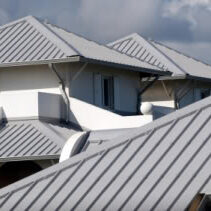
Metal Roofing for Colorado’s Fire-Prone Areas
Colorado’s Front Range sits at the intersection of high winds, wildfire risk, intense hailstorms, and heavy snow. If you’re building or re-roofing in the Wildland–Urban Interface (WUI) or a foothills community, metal roofing can meaningfully increase your property’s resilience while also performing year-round. Here’s what homeowners and property managers should know.
Why metal is a smart choice in wildfire country
- Noncombustible by nature: Steel and aluminum panels are noncombustible and, when installed as a tested assembly, can achieve a Class A fire rating (ASTM E108/UL 790)—a common requirement in many Colorado WUI zones.
- Ember resistance: Interlocking seams and continuous panels shed wind-blown embers better than many overlapping materials. When paired with fire-rated underlayment and properly detailed edges/vents, a metal roof helps reduce ignition points.
- Fewer vulnerable joints: Standing seam systems have fewer exposed fasteners and laps, reducing places for embers and debris to accumulate.
- Quick water shedding: After a fire event, rainstorms often follow. Metal’s smooth surface sheds water and ash quickly, minimizing residue.
Tip: A Class A roof depends on the entire assembly—decking, underlayment, and metal panels—not the panel alone. Work with a contractor who understands tested assemblies and local code requirements.
Hail, wind, and snow performance along the Front Range
- Impact strength: Quality steel panels (proper gauge) resist hail damage better than many traditional materials. AC INC. Roofing is Fortified Roofing Solutions certified—systems designed to withstand 130 mph winds, EF-2 tornado conditions, and up to 2″ hail—adding confidence for Colorado’s severe-storm seasons.
- High-wind security: Correct clip spacing, fastening, and edge metal are critical. Our HAAG-certified inspectors verify attachment patterns and detail terminations at eaves, rakes, and ridges for wind resistance.
- Snow shedding and load: Metal sheds snow faster, reducing prolonged snow load. With appropriate snow guards in walkways and over entries, you can control slide-off while protecting gutters and landscaping.
Fire-hardening details that matter
Even the best metal panel won’t protect a building if weak points are overlooked. During inspection and installation, we focus on:
– Underlayment: Use fire-rated, high-temperature underlayment and ice/water barriers at eaves and valleys to meet code and resist embers and ice dams.
– Eaves and soffits: Enclose open eaves; use metal soffit and ember-resistant venting where required by local code.
– Ridges, hips, and valleys: Tight metal closures and fire-resistant ridge vent systems reduce ember entry.
– Gutters: Embers love dry debris. Choose noncombustible gutters, keep them clean, and consider gutter guards. AC INC. Roofing installs seamless gutters and can integrate them with your roof design.
– Perimeter edge metal: Tested, properly fastened edge metal resists wind uplift and helps block ember intrusion.
– Defensible space: Keep roofs and adjacent areas clear of pine needles and leaves; maintain a noncombustible clearance around the structure.
Energy efficiency and longevity
- Cooler in summer: High-reflectance coatings can reduce heat gain, easing strain on HVAC during Denver’s sunny summers.
- Durable finish: Modern PVDF (Kynar®-type) coatings resist fading and chalking at altitude.
- Long service life: Metal roofing offers a long lifecycle with comparatively low maintenance, supporting strong long-term value.
Choosing the right metal roof for your property
- Profile: Standing seam (concealed fasteners) vs. metal shingles/panels (exposed fasteners). Standing seam excels for weather-tightness and solar-readiness if you plan future additions.
- Gauge and substrate: Thicker steel typically improves dent resistance. Coastal-grade aluminum is preferred near corrosive environments; along the Front Range, galvanized or Galvalume® steel is common.
- Coating and color: Lighter, cool-rated colors reflect more heat; darker colors may accelerate snowmelt. Ask about finish warranties and chalk/fade ratings.
- Assembly: Confirm Class A compliance with your local jurisdiction’s WUI requirements. AC INC. Roofing designs assemblies to meet or exceed code while addressing hail and ice-dam realities.
Why choose AC INC. Roofing
Located at 6145 Broadway, Suite 25, Denver, CO 80216, AC INC. Roofing is a licensed and insured contractor serving the Denver metro, the Front Range, and Cheyenne, Wyoming.
Our credentials and commitments:
– Master HAAG Certified (Colorado’s first company to reach Master level) for advanced inspection and damage assessment
– Fortified Roofing Solutions certified for high-wind and hail-resilient assemblies
– Atlas Pro+ Platinum and GAF Certified contractor credentials for shingle systems, plus Directorii-certified with a customer guarantee up to $20,000
– Members of RSRA (invitation-only), CRA, NRCA, and APA—reflecting our focus on integrity, reliability, and advocacy
– 5.0-star Google rating with excellent reviews
Our services include residential and commercial roofing, storm damage restoration and insurance claims support, roof inspections, repairs, and replacements, roof rejuvenation, siding, and gutter installation. We provide free roof inspections by HAAG-certified inspectors and thorough documentation to support insurance claims.
Our process for fire-prone areas
- Code and risk review: Evaluate your site’s WUI requirements and wind/snow exposure.
- Detailed inspection: Identify vulnerabilities at eaves, vents, valleys, penetrations, and gutters.
- Assembly design: Recommend a Class A metal assembly with appropriate underlayment, edge metal, and fastening schedules.
- Storm-hardening: Integrate hail- and wind-resistant details, snow guards where needed, and ember-resistant venting.
- Documentation: Provide photos, measurements, and line-item scope for seamless permitting and claim support when applicable.
- Ongoing care: Create a maintenance plan for seasonal debris removal and annual checkups.
FAQs
- Will a metal roof attract lightning? No. Metal doesn’t increase strike likelihood; it safely dissipates energy when the structure is properly grounded.
- Is metal roofing noisy? With solid decking and underlayment, interior sound levels are similar to other roofs.
- Can metal roofing help with insurance? Many carriers favor Class A, impact-resistant assemblies, but incentives vary. We can document your roof’s specifications for your provider.
Ready to improve your property’s wildfire and storm resilience with a professionally designed metal roof? Our team is here to help across the Front Range.